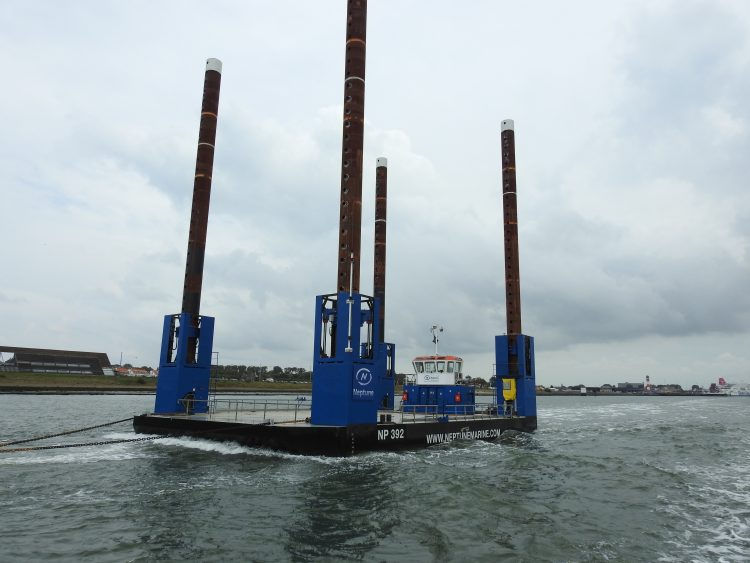
A jack-up platform is a mobile offshore unit that lowers its legs to the seabed and then lifts its entire hull clear of the water. It is an elegant solution — a stable working platform without permanent foundations — but it places enormous demands on the jacking system that raises and holds the structure.
Strength where it counts
During jacking and in the elevated condition, loads concentrate in the chords, pinions and guides that grip each leg. Jacking system strength calculations verify that every component can carry the holding and lifting loads with the margins class requires — in normal operation and in storm conditions.
The role of FEA
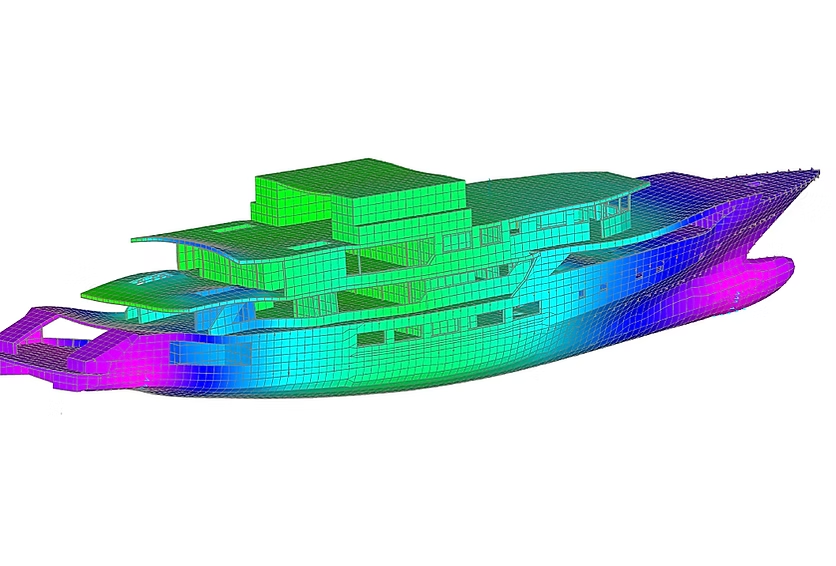
Finite element analysis makes these load paths visible. Local models of the jackcase and leg-to-hull connection show exactly where stress peaks, so the design can be reinforced precisely rather than conservatively. On the IKI Marine NP392 project, this is exactly the work we carried out: jacking system strength calculations that keep the platform standing when it matters most.
Reliability as a design goal
A jack-up may elevate and lower hundreds of times in its life. The engineering goal is not a single successful lift, but a system that performs the same way on the first cycle and the last — quietly, predictably, refined.
Have a structural or marine engineering question? Start a project with IKI Marine →
Learn more about our FEM & structural analysis service →
Frequently asked questions
What is a jacking system on a jack-up platform?
The jacking system is the mechanism — chords, pinions and guides — that raises, lowers and holds the hull on its legs. Its strength is critical to the safety of the whole unit.