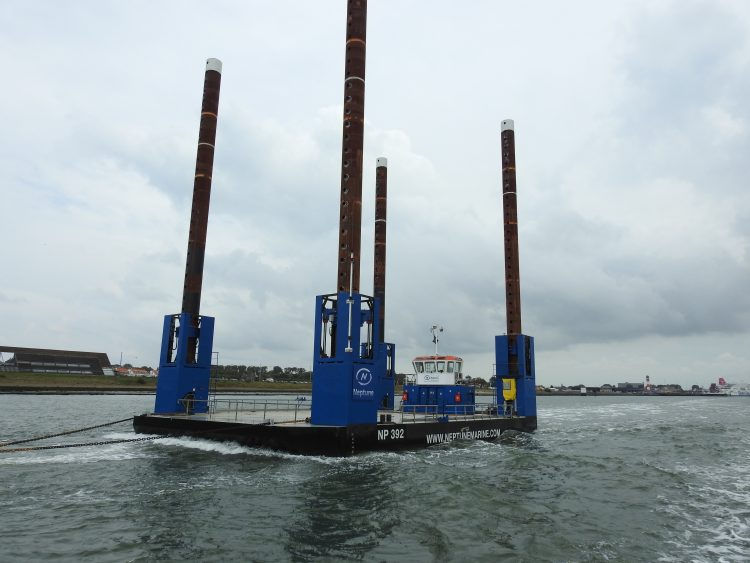
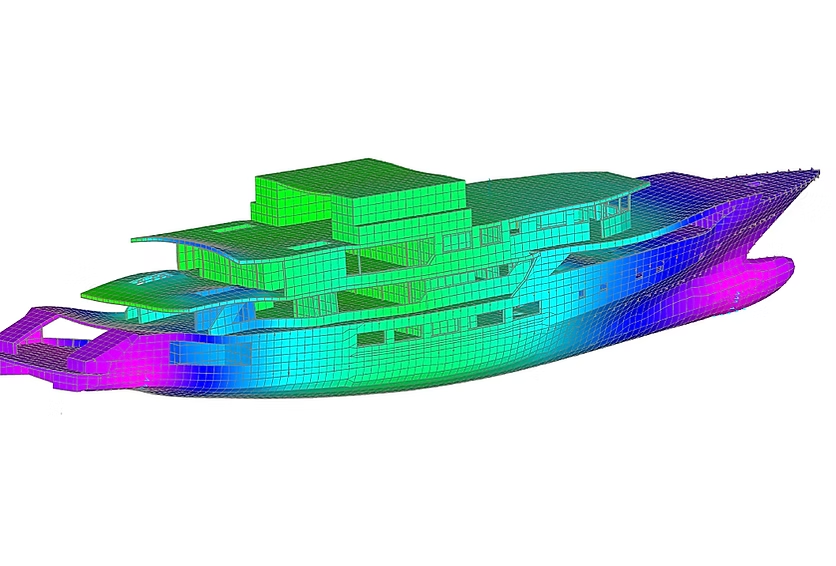
Finite element analysis (FEM, or FEA) is the backbone of modern structural engineering for ships, yachts and offshore structures. Instead of relying on simplified hand calculations alone, FEM divides a structure into thousands of small elements and solves how each one responds to load — giving a detailed, verifiable picture of stress, deformation and buckling.
From load case to verified result
Every credible analysis begins with honest load-case creation. Still-water and wave loads, lifting and transport conditions, ballast and cargo distributions — each becomes a defined scenario the structure must survive. A model is only as trustworthy as the loads it is asked to carry.
Global and local models
A global model captures the overall behaviour of the hull or structure, revealing how loads flow from one region to another. Local models then zoom into critical details — brackets, cut-outs, connections and hard points — where stress concentrates and fatigue begins. Using both together keeps results both realistic and efficient.
Design check, modification and optimisation
Results are checked against the requirements of the relevant class society (DNV, Bureau Veritas, ABS, Lloyd's Register and others). Where the structure is over- or under-utilised, the model becomes a design tool: material is removed where it does nothing and added where it earns its place. The outcome is a structure that is lighter, stronger and certifiable.
Why it matters
Good FEM work is quiet. It prevents the failures nobody sees, shaves steel weight that would otherwise cost fuel for decades, and gives yards and owners the confidence to build. That is precisely the spirit of iki (粋) — refinement until nothing unnecessary remains.
Have a structural or marine engineering question? Start a project with IKI Marine →
Learn more about our FEM & structural analysis service →
Frequently asked questions
What is the difference between FEM and FEA?
They refer to the same thing. FEM (finite element method) is the underlying numerical method; FEA (finite element analysis) is its application to engineering problems.
Which class societies does FEM analysis support?
FEM results are typically checked against DNV, Bureau Veritas (BV), ABS and Lloyd's Register (LR) requirements, among others.